
Why Does My Child Have Big Meltdowns Over Small Things?

You ask your child to put on their shoes.
They cry and refuse.
You tell them it is time to leave the playground.
They throw a tantrum.
Their sibling touches their toy.
They use their body instead of their words.
You may find yourself wondering, “Why is this such a big deal?”
Sometimes what seems like no big deal to us can feel very big to a child's nervous system, especially when they are lacking the foundational skills to navigate frustrating circumstances with ease.
When a child is having frequent or intense meltdowns, it can be helpful to look beyond the behavior and ask:
What lack of skill is making this situation difficult for my child?
Regulation Is a Skill

Children are constantly taking in information from the world around them.
They hear someone talking and have to filter out the background noise to “tune in”.
They sense their own movement and body position in space.
They feel different textures such as clothing and tags against their skin.
They notice people moving around them.
They are also expected to be able to stop one activity and begin another, follow directions, “read” their peers socially, and manage unexpected changes.
That's a lot!
When a child's sensory system is having difficulty processing the information around them, they may become overwhelmed more quickly.
What looks like a “small” trigger may actually be the last thing added to an already overloaded system.
Look at What Happens Before the Meltdown

Behaviors are “just the tip of the iceberg” meaning we have to consider what is going on beneath the surface.
One helpful thing to do is become a detective.
What was happening right before your child became upset?
Were they:
In a loud or crowded environment?
Tired or hungry?
Transitioning away from something they enjoyed?
Asked to complete a difficult task?
Experiencing an unexpected change?
Wearing clothing that bothers them?
Having difficulty understanding what was expected?
Already having a hard time regulating?
Sometimes there are clues that tell us what your child was experiencing before the big emotion appeared.
consider how you navigate challenges and demands when you feel stressed or overwhelmed already, compared to how you navigate things when you are well-rested and feeling at ease or in control.
Think about “skill” not “will”… Do they have the tools?
We often talk about how children have a natural and intrinsic desire to do well and succeed. if a child is demonstrating avoidance, non-compliance, or disobedience, it is more likely that they do not feel equipped rather than that they do not have the desire.
Your child may have the will to get dressed and ready for the day, but not yet have the skills to manage all of the sensory information involved.
They may want to play with their friends, but have difficulty navigating the unexpected changes that happen during play.
They may want to listen to their teacher, but have difficulty maintaining a ready-to-learn level of arousal in a busy classroom.
They may want to stop one activity in order to start the next, but have difficulty shifting from one activity to another.
This doesn't mean that every difficult behavior is caused by sensory processing.
It means that behavior gives us information.
What Can Help?

First, take care of your own state of regulation.
As parents, we can help co-regulate our children, but it is much harder to do that when we are already overwhelmed ourselves.
When your child begins to become dysregulated, you can try:
Offering simple, acceptable choices
Using fewer words
Taking slow breaths together
Giving your child a moment to process what you have said
Providing movement or “heavy work” when appropriate
Reducing unnecessary sensory input
Preparing your child for transitions (such as a 3-min heads up)
Helping your child identify what they are feeling
work together to come to a solution to the problem. invite your child into the decision making process.
Most importantly, try to stay curious.
Instead of only asking, “How do I stop this behavior?”, ask:
“What is my child communicating, and what skill might they be lacking?”
When Should I Seek Help?
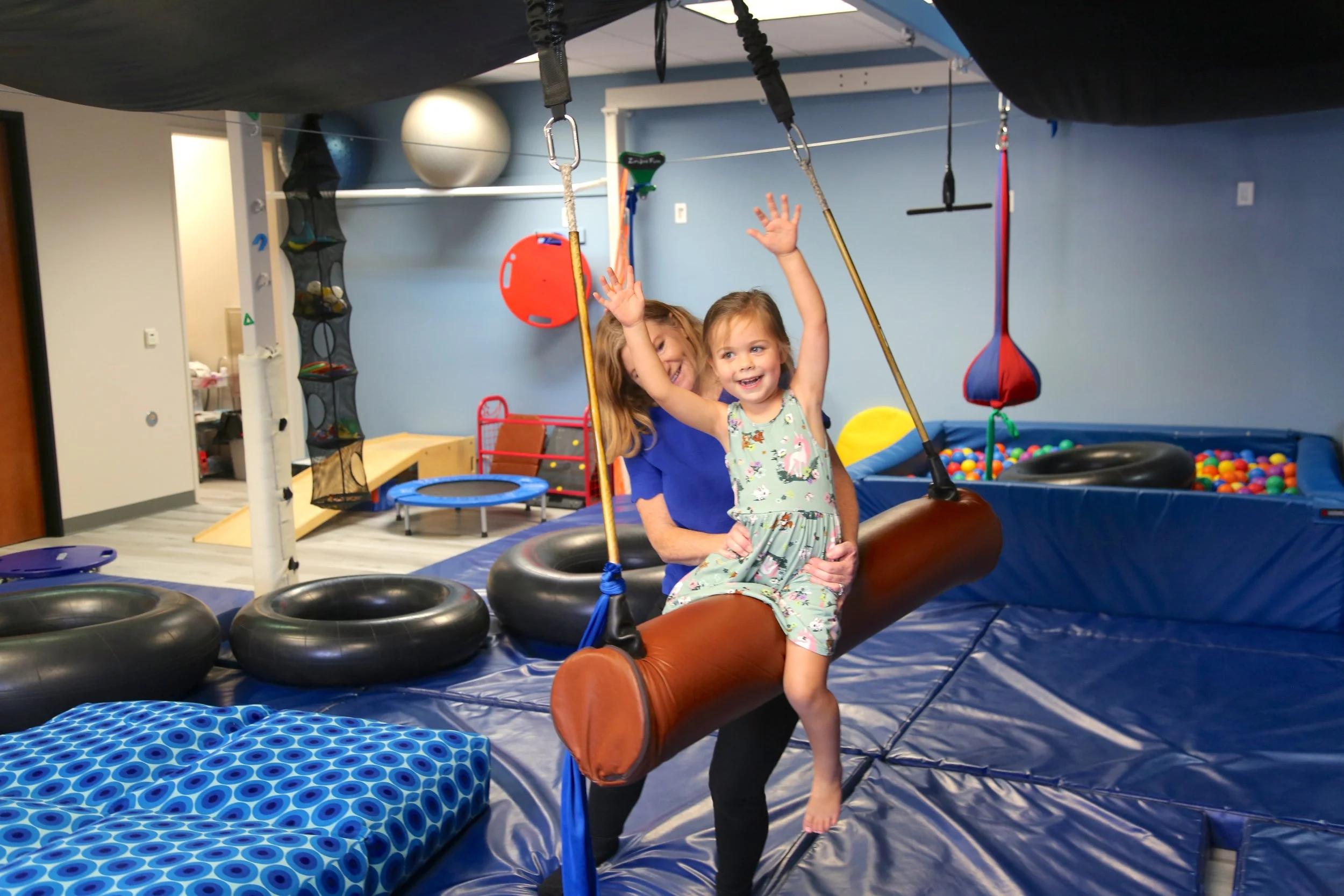
If your child's meltdowns are frequent, intense, or interfering with family life, school, friendships, or everyday activities, it may be helpful to talk with a pediatric occupational therapist.
At The LaunchPad, we look at how sensory processing, motor skills, praxis, regulation, and other underlying skills may be affecting your child's ability to participate successfully.
We look at:
The vestibular system (which is foundational for cerebellar functioning, organizing sensory information, and for self-regulation i.e. the ability to maintain an even emotional tone, tolerate frustration, and maintain a general sense of well-being)
Proprioception (which gives us our body schema and supports self-regulation)
Interoception (which helps us sense when we are hungry, thirsty, tired, or in need of the restroom)
Auditory, visual, and tactile processing
Praxis skills (or the ability to organize oneself to act upon the environment in a meaningful and efficient manner)
Our goal is not to eliminate emotions.
Children are allowed to have and express big feelings.
Our goal is to help children develop the skills they need to navigate those feelings, respond to their environment, and participate more successfully and with greater ease in their everyday lives.
And remember: you are the expert in your child.
Sometimes the first step is simply having someone help you understand what you are seeing.